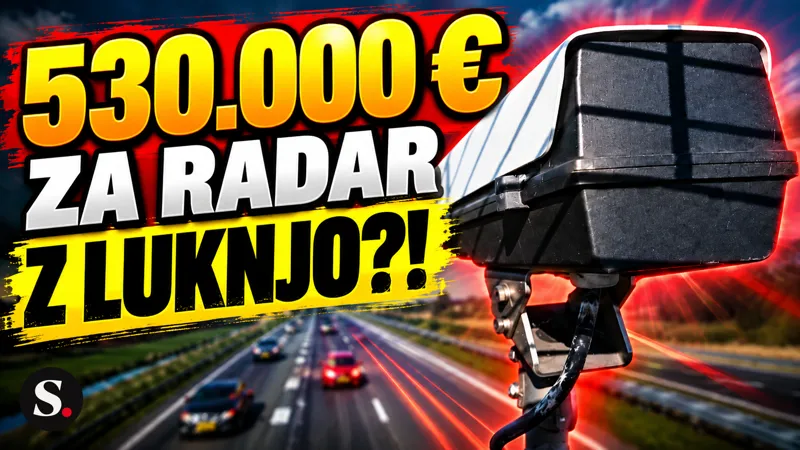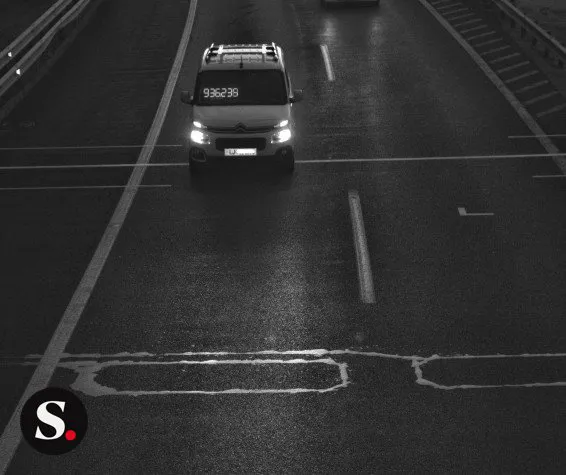
Half of Dolenjska thinks section radar is already fining them. They're wrong, for now.
All four section speed cameras on Slovenian motorways are now officially certified and the signs are already up, but no fines are coming yet, even though plenty of people in Dolenjska assume otherwise.
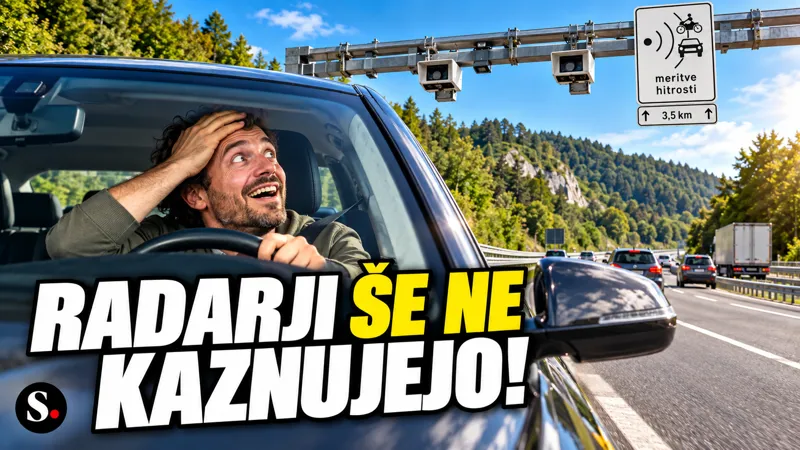 Illustration: AI
All four section speed cameras on Slovenian motorways are now officially certified, warning signs stand by the roads, and word is spreading on social networks that somewhere they are already fining speeders. The truth is duller: nowhere yet.
The most persistent rumour concerns the stretch between Grosuplje and Ivančna Gorica through the Višnja Gora climb. Drivers in Dolenjska (Lower Carniola) have been sharing a post claiming the radar has already started measuring there. The portal NaDlani.si checked the official data and found it was a mistake: the devices are indeed installed and certified under metrology rules, but the police do not yet use them regularly, so no fines are being issued on their basis.
The confusion is understandable. Cameras are on all four sections: between the Logatec and Vrhnika junctions, between Ljubljana Brod and Vodice, over the Višnja Gora climb between Grosuplje and Ivančna Gorica, and at the Trojane tunnels between Podmilj and Ločica. They have been installed for a while and, since mid-September, all are also officially certified. A driver who spots them by the road therefore reasonably concludes that he is already being monitored. In reality it may only be technical checking and testing of the equipment, not the actual issuing of payment orders.
"On this basis, the results of speed measurements on these sections may begin to be used for speeding proceedings under the road traffic rules act." (translated)
That is how the metrology office commented on the certification of three sections at the start of September, adding that this does not yet mean measuring has begun. Before actual launch, the supplier must train police officers, and the system must be linked to the police information system. Tests of the whole chain, from camera to payment order, follow. Only then will the police, not DARS, the state motorway company, announce the official start date.
The timeline is a story in itself. The system was supposed to start in March, then in May, then by the end of July, and in August September was announced. October is here, all the radars are certified, and there is still no start date.
The variable speed limits on the gantries above the motorway are a special case too. When the limit is temporarily lower because of roadworks or heavy traffic, section measuring, as currently designed, simply does not apply on that stretch.
"If the operator limits the speed because of roadworks or any other reason, section measuring will not be carried out on this stretch." (translated)
This was explained by Matjaž Leskovar, senior independent police inspector from the traffic police sector at the General Police Directorate.
While DARS and the police are still coordinating paperwork, the automobile association AMZS added a feature to its mobile app at the start of September that calculates a driver's average speed on monitored sections in real time, before anyone else does it for the purpose of fining. So DARS still has no working system, but the driver's own phone app already knows how fast they are going.
For drivers, then, the rule is simple: the limits on these four sections apply whether or not section measuring is already monitoring speed. Once it does start working, braking just before the camera will no longer pay off. Until then, you can drive through the Trojane tunnels and over the Višnja Gora climb as fast as you dare, and the signs by the road will just watch.
Sources
- Po Dolenjski se širi zapis, da je sekcijski radar pri Višnji Gori začel delovati: preverili smo, kaj drži
- Vozniki sprašujejo, ali sekcijski radarji že merijo: zdaj je DARS jasno povedal, kaj se dogaja
- Zelena luč za sekcijsko merjenje hitrosti, ki pa se še ni začelo
- Sekcijsko merjenje hitrosti v Sloveniji: kje bo in ali že deluje leta 2026?
Saj ni res. is an independent Slovenian newsroom. This is an English translation of our Slovenian story; the Slovenian original is authoritative.