€530,000 for a speed trap you can beat by taking one motorway exit
Section speed measurement on four motorway stretches still does not work. When it does, you will be able to beat it perfectly legally: just leave the motorway in the middle of the stretch.
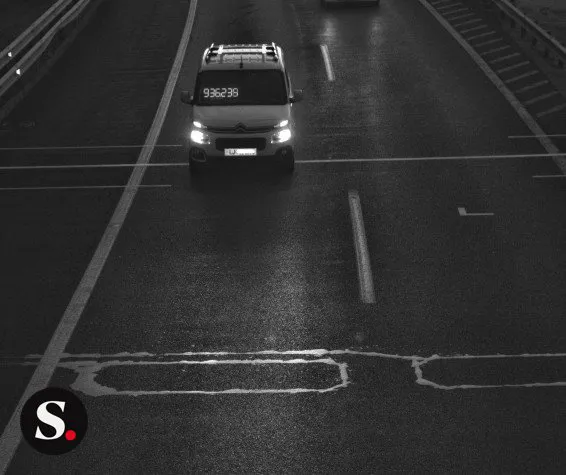
 Illustration: AI
Section speed measurement, which the Motorway Company in the Republic of Slovenia (Dars) has been announcing since spring, still does not work on Slovenian motorways. The system, for which the state paid a good half a million euros, has not only been delayed but also has a design flaw. On three of the four measured stretches there are no cameras at the intermediate exits and entrances, so a driver can simply leave the motorway in the middle of a stretch and vanish from the measuring system.
Once it finally goes live, section speed measurement will operate on four stretches: on the Primorska motorway between Logatec and Vrhnika towards Ljubljana, on the Gorenjska motorway between the Ljubljana Brod and Vodice junctions towards Kranj, on the Dolenjska motorway over the Višnja Gora hill between Grosuplje and Ivančna Gorica towards Novo Mesto, and on the Štajerska motorway between Podmilj and Lončica, that is, in the area of the Trojane tunnels, towards Maribor.
Unlike a classic radar, which measures instantaneous speed at a single point, section measurement captures the vehicle at the start of the stretch and again at the end, and calculates the average speed from the driving time. The aim is not punishment at any cost but calming traffic along the whole stretch, not only in front of the camera.
According to the original plans, the system was supposed to go live in March, then in May, then by the end of July. Now Dars gives only "September" as the deadline, with no exact date. July passed without radars, and in August the metrology office officially approved three stretches: between Logatec and Vrhnika, between Ljubljana Brod and Vodice, and over the Višnja Gora hill. The fourth, at the Trojane tunnels, had to wait longer, though not through the contractor's fault. While fixing deficiencies at the measuring site in August, Dars removed the cameras, which it was not allowed to do, and the contractor, Intermatic, had to install the system again. The metrology office gave the green light for the fourth stretch only on 16 September.
"Before the start of operational section speed measurement, the final activities of all participants are still under way." (translated)
Dars picked Intermatic in a tender. The company offers the iCar5 measuring device from the Belgian manufacturer MacQ. The contract is worth €530,000 including tax, and Dars has the right to charge a penalty of €1,059 for each day of delay, up to a maximum of ten percent of the contract value. Whether it will actually enforce the penalty, it did not say.
Even when the system finally starts working after all the certifications, training and testing, it will not work the way one would expect. On three of the four stretches there are intermediate exits and entrances with no cameras. Anyone who joins the motorway in the middle of a measured stretch, or leaves it before a second camera captures them, does not exist for the system, so their average speed cannot be calculated.
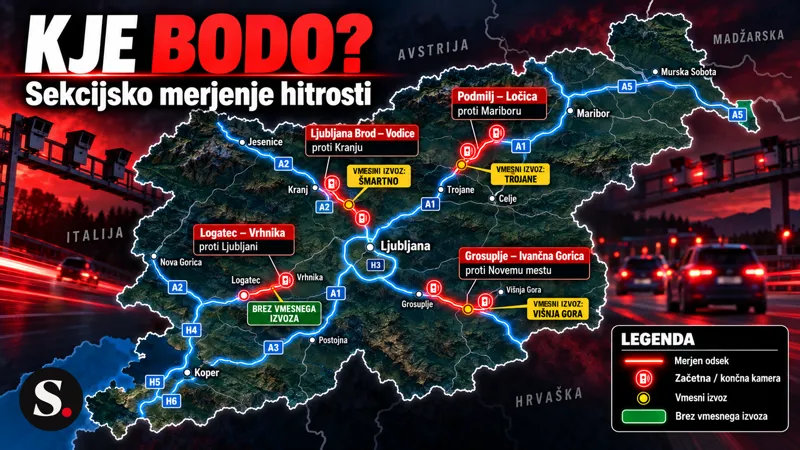
"Which means we have installed section measurement where in certain cases you can simply leave the section and no longer exist for the system." (translated)
The same hole gapes open with variable speed limits on the gantries above the motorway, which Dars uses more and more often. When the limit on a measured stretch changes, for example from 130 to 80 kilometres per hour because of roadworks or heavy traffic, the system as currently designed does not take this into account automatically. The system is supposedly to be adapted to variable limits only with one of the future software upgrades, that is, when the adaptation will again have to be paid for under a new contract.
Even when all four stretches are officially certified, that does not yet mean fines will start arriving in mailboxes. The measurements will be taken over by the police, not Dars, and the contractor must first train police officers and fully connect the system to the police information system. Only after a test period will the police announce the official start date. Until then, you can drive as fast as you like on those four stretches, and the radar will just quietly count the minutes.
So section speed measurement officially does not exist yet, and unofficially it is worth half a million euros and has a hole big enough to drive a whole car through.
Sources
Saj ni res. is an independent Slovenian newsroom. This is an English translation of our Slovenian story; the Slovenian original is authoritative.