Petrol warns diesel could reach €3 a litre after 20th price rise
Since the US attack on Iran, fuel has gone up in price twenty times, and diesel is 36 percent dearer. The director of Petrol, the Slovenian fuel retailer, does not rule out a price of three euros a litre.
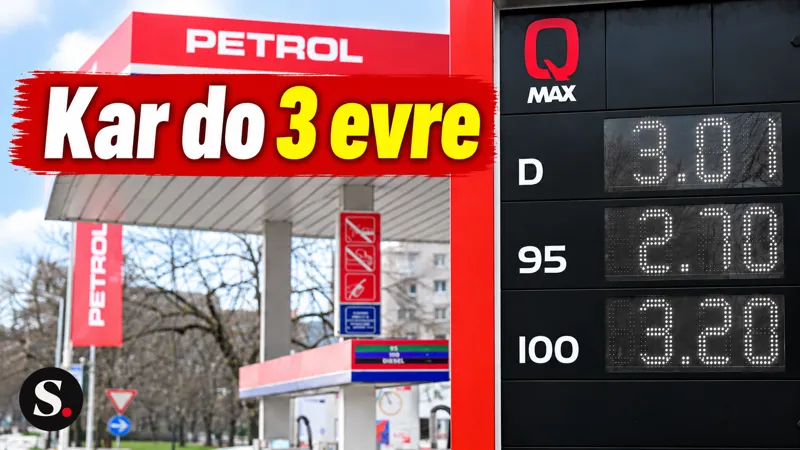 Illustration: AI
Regulated fuel prices went up again on Monday evening. A litre of 95-octane petrol is 2 cents dearer and now costs €1.748. Diesel crossed two euros a litre for the first time ever: it rose by 2.1 cents to a record €2.012. Heating oil jumped the most, by 3.3 cents, to a record €1.635. The prices apply until and including 28 September.
This is not the first price rise this month, and it will not be the last:
"Since the American attack on Iran, fuel prices will rise tomorrow for the twentieth time, and so far petrol has become 20 percent more expensive and diesel as much as 36 percent." (translated)
At the end of last week, Petrol director Saša Berger said where he thinks the price could go if the situation in the Middle East does not calm down:
"If the conflicts continue in this form or escalate further, I do not rule out that the price could go to 2.5 or even three euros per litre of fuel." (translated)
Meanwhile, the government has reached for the only lever it has left, and it helps home heating, not drivers. On Monday it amended the decree setting the excise duty on energy products, cutting the duty on heating oil further. The amendment lowered the legally set €157.50 per 1,000 litres to €42. The government then used the option of an additional 50 percent cut and brought the duty down to €21 per 1,000 litres, the lowest level the European directive still allows. Excise duty on diesel and petrol stays unchanged, because for diesel it is already at the lowest permitted level (€0.33 per litre). To go lower, Slovenia would need permission from the European Commission. It has asked for it but has not yet received an answer.
The Government Communication Office described the move like this:
"With the change in excise duty, the retail price of extra light heating oil will rise less than it would have without the change. The government has thus used all the options currently available under the legislation, and in doing so has eased somewhat the pressure of rising prices of goods and services on consumers and households." (translated)
In other words: even with the reduced excise duty, heating oil hit a record. It would have risen even more had the government not stepped in. For diesel and petrol there is no such lever. The excise duty is already at the floor, the government raised retailers' margin to 11.5 cents per litre in June, and under the European directive VAT cannot be lower for motor fuels. Meanwhile, petrol stations can set prices freely on motorways and expressways, where there has never been any regulation.
Germany announced on the same day that it will consider a cap on fuel prices at the pumps. Slovenia, for now, is waiting for Brussels.
Sources
Saj ni res. is an independent Slovenian newsroom. This is an English translation of our Slovenian story; the Slovenian original is authoritative.