
Triglav glacier is gone: 14 hectares in 1946, nothing today
Austria's Der Standard reports that the last ice under Slovenia's highest mountain has melted completely, leaving the country with a single glacier.
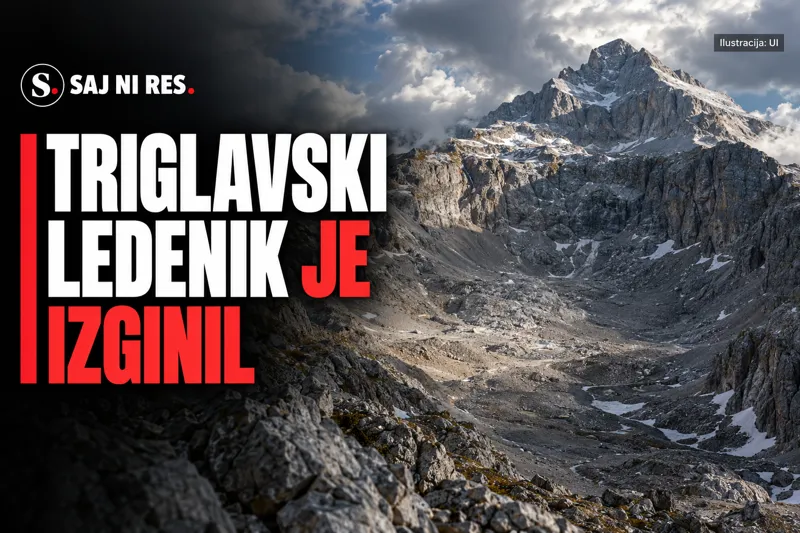 Illustration: AI
Austria's Der Standard has reported that the glacier under Triglav has melted away completely. The paper cites Britain's Guardian, according to which the last ice vanished on October 19. By that estimate Slovenia now has just one glacier left, the one under Skuta in the Kamnik-Savinja Alps.
Der Standard stresses that at 2,864 metres Triglav is Slovenia's highest mountain and that it appears on the national coat of arms. Between 1983 and 2003 the glacier reportedly lost 93 percent of its surface. We have not seen the Guardian article, so the October 19 date remains attributed to Der Standard.
The disappearance is also confirmed by researcher Miha Pavšek of the Anton Melik Geographical Institute at ZRC SAZU (the research centre of the Slovenian Academy of Sciences and Arts), who has been measuring the glacier since 1946. The US news agency AP and Euronews, which picked up its reporting, published his words on October 15 about what was left of the ice:
“When measurements began, the Triglav glacier covered a little more than 14 hectares. Five or ten years ago we were talking about half a hectare to one hectare. In recent years it was less than 0.2 hectares, and the ice has now, as I said, disappeared completely.” (translated)
The news was no surprise. On September 10 the Government Communication Office had already announced that the glacier had shrunk to individual patches of ice and that, based on observations from the end of August, its last remnants would "very likely" vanish by the end of this year's melting season.
“After 80 years of regular measurements, we have reached the point where we are no longer monitoring just the shrinking of the Triglav glacier, but its actual disappearance.” (translated)
The reason is simple: the winter was almost snowless and the summer very hot. The maximum snow depth at Kredarica, the high-altitude weather station below Triglav, was 220 centimetres, against an average of 374 centimetres in the period from 1991 to 2020. The last day with snow at Kredarica was May 31, while in that period it still had about a metre and a half of snow on average on June 1.
When regular measurements began in 1946, the glacier under Triglav measured about 14 hectares. According to Pavšek, the glacier under Skuta is following the same path: it covers about 1.5 hectares, and the ice has thinned from several tens of metres to a few metres.
For Slovenes this is not just a curiosity for mountaineers. Pavšek warns that glacial meltwater feeds rivers, including the Drava and the Mura, and they in turn feed the groundwater from which we draw drinking water. According to the latest forecasts, all glaciers below 3,500 metres above sea level in the Austrian Alps are expected to disappear by 2050.
Ice remains beneath the surface. According to Pavšek, there is still plenty of it in the nearby Triglav Chasm, where at a depth of 250 metres lies one of the larger cave ice bodies.
Sources
Saj ni res. is an independent Slovenian newsroom. This is an English translation of our Slovenian story; the Slovenian original is authoritative.