Slovenes make up to 40 percent of visitors to Tito's Cave in Drvar
The curator of the memorial complex in Bosnia says Slovenes are the most numerous guests, mostly aged over 55. Germans follow, and before 1991 the complex drew 200,000 people a year.
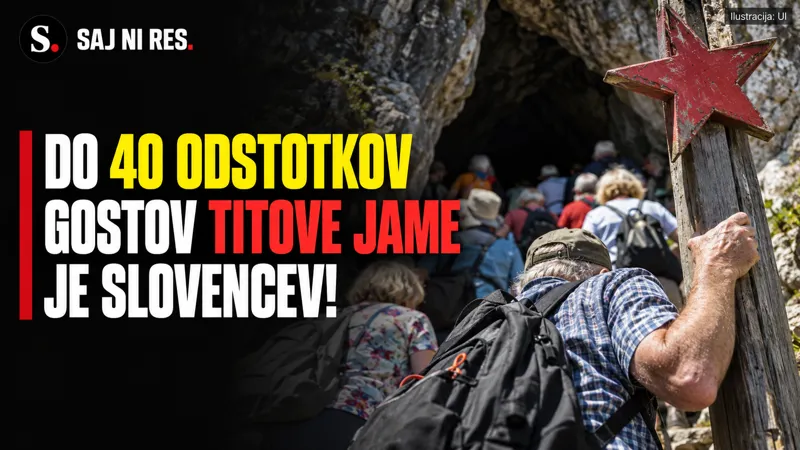 Illustration: AI
On Saturday, the church of St Joseph was consecrated at the entrance to Drvar in south-western Bosnia, with Croatian Prime Minister Andrej Plenković among those attending. A kilometre further on, at the town's exit, a bus carrying about fifty excursionists from Slovenia and Istria, mostly from Buzet, parked in front of the "25 May 1944" memorial complex. They had come to see Tito's Cave and other Yugoslav monuments built to commemorate the German airborne assault on Drvar in 1944, when German units tried to capture Josip Broz Tito. So writes Croatian N1, citing a report by the Hina agency.
Dušan Dragoš, curator of the "25 May" museum, estimates that Slovenes are the largest group among visitors: 30 to 40 percent of the total. Foreigners, including citizens of the states that emerged from the breakup of Yugoslavia, are said to make up around 70 percent of guests. Among visitors from outside the former country, he says, Germans are the most numerous.
The curator described the Slovenes like this:
"These are mostly people aged around 55 and over, people who remember life in Yugoslavia. They tell me that life has never been as good for them as it was in that period." (translated)
According to Dragoš, Slovenian visitors express nostalgia for that time and speak of Tito with great respect. Saturday's guests from Buzet and Slovenia did not want to talk much with journalists. They briefly expressed regret that, in their view, today's generations do not live by the ideals of anti-fascism as their predecessors did, and they were particularly appalled by what happened before the Hajduk match.
From 200,000 a year to a few thousand
The complex, centred on Tito's Cave, was declared a national monument of Bosnia and Herzegovina in 2011. Between 1950 and 1991, according to N1, it received around 200,000 people a year. Today the numbers are far more modest: in the whole of 2025 the complex was seen by 3,500 to 4,000 people, and between 8 July and 18 August this year alone about 2,000 were counted.
Dragoš notes growing interest. Guests come from almost every part of Europe, but also from Australia, Canada, the USA, Japan, Palestine and Singapore. In his view, the complex could present itself better with relatively modest investment. The buildings are in relatively good condition, although many need repairs, and investment so far has been minimal and mostly funded by entrance fees.
At the entrance stands a wooden pillar with a red five-pointed star and a signpost giving distances in kilometres to places that had Tito's name in theirs. Drvar was one of them, and in Croatia, Korenica. A demanding mountain trail leads to the cave, but the path alongside it is closed.
After the turbulent Saturday, the town returned to its usual rhythm. According to N1, the local Croatian and Serb communities are struggling with economic hardship and constant emigration. They judge the past differently, but look at the future with equal hopelessness.
Sources
- Grad u kojem Tito još živi: Posjetitelji dolaze iz gotovo svih krajeva Europe. Najviše je Slovenaca, Nijemaca... „Najviše je Slovenaca. Njih je između 30 do 40 posto ukupnog broja gostiju.“
Saj ni res. is an independent Slovenian newsroom. This is an English translation of our Slovenian story; the Slovenian original is authoritative.