Crete: 361 Millimetres of Rain in Just Over a Day, One Dead, Now a Second Storm
After record rainfall that claimed one life and led to a state of emergency until the end of December, the Greek island got a second storm in the same week, before it had even cleared the debris from the first.
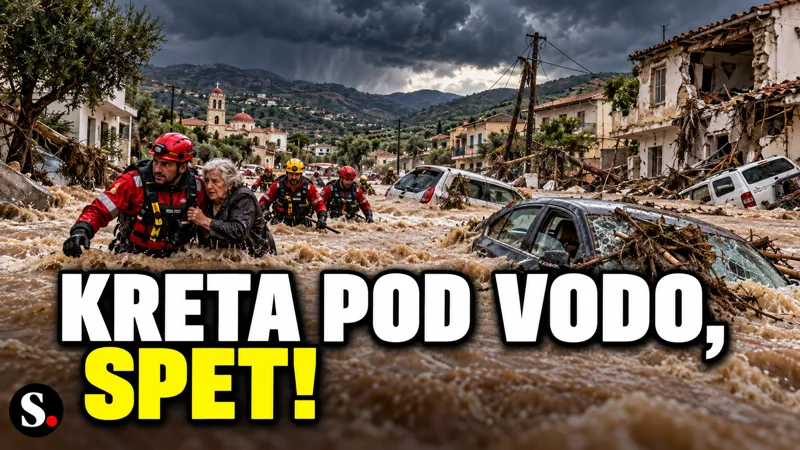 Illustration: AI
After the record rainfall at the end of September, Greek Crete had no time to catch its breath: it had barely declared a state of emergency when another storm arrived.
The National Observatory of Athens recorded 361.4 millimetres of rain in the village of Anogeia between 30 September and noon on 1 October, an exceptional amount by local standards. The worst-hit areas were the north and the mountainous parts of the island, above all the regions of Heraklion, Lasithi and Rethymno.
The downpour flooded roads, damaged bridges and triggered landslides. Firefighters received more than two hundred calls for help and carried out dozens of operations pumping water out of homes and businesses. They also rescued people trapped in flooded vehicles.
The storm also claimed a life. An 80-year-old livestock farmer from the area around Karines in the municipality of Agios Vasileios was swept away by the water as he went to check on his sheep pen. He had been missing since the middle of the night and was found dead under debris carried down near a stream.
In Livadia, a married couple drove their vehicle into a riverbed after the water damaged the road beside a bridge. Both were taken to the hospital in Iraklion, where according to initial reports their lives were not in danger.
On 1 October a state of emergency was declared in the municipality of Mylopotamos. It will remain in force until 30 December 2026, while the authorities assess the damage and carry out repairs. Schools and childcare facilities are closed, and the Samaria Gorge is closed to visitors. Across Crete, a so-called red level of civil protection mobilisation was in force from 30 September to 4 October. That means the entire network of rescue services, local authorities and equipment was on the highest alert because of the forecast flood danger.
Then, before the island had cleared the debris from the first storm, the second one came. On Friday, 2 October, conditions worsened again, and the Greek meteorological service Meteo placed the forecast rain in the fourth, "very significant" category on its rainfall intensity scale. In Mylopotamos, residents were again told via the 112 emergency number to avoid unnecessary travel, a torrent near Zoniana burst its banks for the second day in a row, and firefighters moved two minors from one home to another as a precaution.
Civil protection warned that after the first wave the ground is already saturated with water and the infrastructure is damaged, so even less intense rain can be dangerous.
Near Karteros, close to Iraklion, the storm caught a family by surprise in the middle of the night. Lightning struck the chimney of their house, and all three of them jumped out of their beds.
"We thought it was a bomb!" (translated)
The father, Antonis Petrakis, described the incident to the website Cretalive.gr. All three family members woke up at the noise and escaped from the house unharmed.
The authorities expect a full assessment of the damage only once the weather finally eases. Until then, their priority remains the same: keeping roads passable, protecting residents and responding to every new flood.
Sources
Saj ni res. is an independent Slovenian newsroom. This is an English translation of our Slovenian story; the Slovenian original is authoritative.