Matoz has a year for 206,902 civil servants. For Janša's 50,000 departures, he has none.
For 2028, Matoz calculated 206,902 public employees. For the 50,000 departures announced by his prime minister, he calculated no year at all.
Alenka Bratušek, an MP for the Freedom Movement (Svoboda), put a question with a single number in it to Interior Minister Franci Matoz in the National Assembly (DZ): the share of all employed people in Slovenia who work in the public sector is 16.8 percent, while the OECD average is 18.4 percent. The question was about the share. The share says that, compared with others, we have too few.
The minister answered about growth. Since 2015, when the debate on debureaucratisation began, public sector employment has risen by 17.1 percent, or 28,665 people. If growth continued at the same pace, 206,902 people would be employed by 2028. That would be, he said, hard to sustain for public finances.
He did not answer the question about the share. He answered a question nobody had asked.
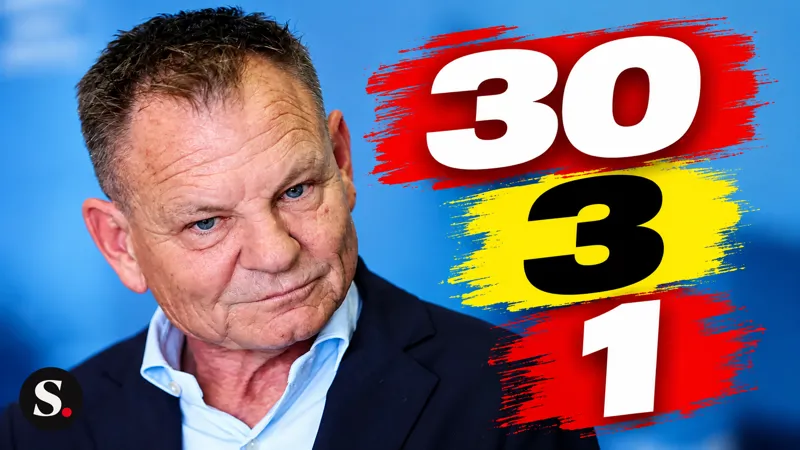
Thirty, three, one
The most telling part of the minister's appearance was not the projection but the example he gave as proof that optimisation works: the reform of the public tender at the personnel centre.
Eleven days instead of three to six months. The procedure is run by three people, and with artificial intelligence, in his estimate, only one will be needed.
The same minister cited the same example ten days earlier, on the sidelines of a press conference:
"He has experience with work at a ministry that used to be done by 30 employees, and with optimisation and digitalisation, and now with artificial intelligence too, it could be done by three." (translated)
Thirty, three, one. The same task, two ministerial statements within ten days, and the number shrank both days. That is a 99 percent cut, presented as an example of good practice. It is also the most honest sentence in the whole debate, because it shows how the 50,000 is imagined. Not as a transfer. As the same work done by a fraction of the people.
There is a word for that, and it is not "flowing into the economy".
The number 206,902 is a straight line
The minister himself says where it comes from.
"It is simply an algorithm of calculations based on the constant growth recorded over the last ten years." (translated)
Here "algorithm" is a polite word for a ruler. You take the last ten years, extend the line two years ahead, and get a six-digit number you can say in parliament. Precision down to the last employee, 206,902 and not 206,900, is decoration in a forecast drawn with a ruler, not data.
The other number, which nobody has calculated, is more telling. For growth that will not happen, the minister has a year. For the fall the government announces, he has none.
The subtraction
Five days ago at the MOS trade fair in Celje, Prime Minister Janez Janša announced that roughly 50,000 employees should gradually flow from the public sector into the economy, without dismissals, through natural attrition.
Now let us subtract.
At the end of 2025 the public sector had 196,123 people. Matoz's 28,665 means there were roughly 167,500 in 2015. Subtract Janša's 50,000 and about 146,100 remain.
That is not a return to 2015. It is more than 21,000 people below 2015. It is barely twenty-odd thousand above the number at independence, in a country that has since joined the European Union and NATO.
The same minister said in the same answer that the number had grown, although there were no changes like those after independence or after joining the EU and NATO. The plan he defends takes staffing back to below the level at EU and NATO accession. The obligations to the EU and NATO remain.
What happens to the percentage the question was about
N1 also noted, alongside Janša's announcement, that Slovenia is below the OECD average. But nobody took the next step.
The plan explicitly promises that nobody is left without a job: people would simply move to the economy. So the total number of employed people in the country stays the same, at roughly 1,167,000.
If the public sector shrinks to 146,100, the share falls from 16.8 to roughly 12.5 percent.
The gap to the OECD average is 1.6 percentage points today. After the plan, it would be 5.9 percentage points. The MP warned that we are below the average; the proposed solution nearly quadruples the gap.
There is no ministerial comment on this, because nobody asked.
From which houses
That leaves the question the government dodges every time it comes up: where do these 50,000 come from?
Opposition leader Robert Golob pointed out that all ministries, administrative units and municipal administrations together employ around 20,000 people, and asked: "So where would he cut? In hospitals, the police, care homes for the elderly, kindergartens?"
The number matters more here than the politician who said it. If it holds, 50,000 is two and a half times all state and municipal administration combined. A plan the government describes as a cut in bureaucracy is therefore arithmetically impossible to carry out in bureaucracy. The difference has to come from hospitals, schools, kindergartens, care homes and the police, or the government has to say where else it would come from.
Associate Professor Valentina Franca of the Faculty of Administration told N1 what is missing from the announcement:
"You simply cannot move a person from the public sector to the economy just like that. There are legally defined procedures for termination and dismissal. These are not Lego bricks that could simply be moved from one pile to another." (translated)
The police are his
Matoz regretted that employment had not grown in sectors such as the army and the police. The government analysis he presented shows growth across the whole public sector except the police and the army.
The police fall under his authority. So in an answer whose main thesis is that there are too many public servants, the interior minister regretted that there are not enough in his own house. Both claims can hold at once, but then this is a story about redistribution, not about numbers, and the figure of 50,000 has no business in it until you know which sectors it comes from.
Just as awkward is the comparison of governments published by N1: relative to the length of the term, the number of employees in state administration grew fastest under the third Janša government, by an average of 28 people a month, compared with eight under Šarec and 17.9 under Golob.
Why this is a story about wages
Janša's announcement in Celje was not a standalone one. It came in the same breath as a warning about the wage reform, which envisages six raises, three of which have been carried out.
"Slovenian finances cannot bear them at this productivity, I can say that in advance, with the same number of employees." (translated)
The final phrase, "with the same number of employees", is the whole sentence. The remaining raises are not cancelled. They are tied to the number of employees not staying the same. That is not an announcement of reorganisation. It is a condition.
Asked whether this means there will be no December raise, the Ministry of Finance replied:
"We do not comment further on the Prime Minister's statements at the Ministry of Finance." (translated)
Finance Minister Andrej Šircelj meanwhile insisted: "We will not introduce any Zujf." (Zujf was the 2012 austerity law.) The government is denying in advance a measure that nobody has officially proposed. That rarely comes out of nowhere in Slovenian politics.
And in June, when he was merging three portfolios, the same Matoz said what it is called when there is no need to be careful:
"All this means that, if necessary, certain jobs will be abolished because of duplication." (translated)
What is missing
- A year. When is 146,100 supposed to be reached? The minister's method, the straight line, would calculate it in a minute. He has not calculated it. - A breakdown by sector. How many of the 50,000 from health, how many from education, how many from administration, how many from municipalities. Without it the number is a slogan. - A natural attrition rate. "Without dismissals" is a verifiable promise only if you know how many people leave on their own each year. The government has not published that number. - An answer to the MP. The question was about the 16.8 percent share. The answer contains not a single word about it.
For now we have one firm number about the future, 206,902, and it describes a world in which the government does nothing. For the world the government is announcing, we have none.
Sources
- N1/STA: Matoz o rasti zaposlovanja od leta 2015
- N1/STA: Matozova projekcija za leto 2028 in vprašanje poslanke Bratušek
- RTV SLO: Matoz o primeru 30 zaposlenih in o presežnih delavcih
- N1: Golobovo vprašanje, podatek 196.123 in primerjava vlad
- N1: Valentina Franca, Fakulteta za upravo
- RTV SLO: Janša o dvigih plač in molk ministrstva za finance
- 24ur: Matoz junija 2026 o ukinjanju delovnih mest
- 24ur/STA: Janša bi 50.000 zaposlenih preusmeril v gospodarstvo
Saj ni res. is an independent Slovenian newsroom. This is an English translation of our Slovenian story; the Slovenian original is authoritative.