40,960 Signatures Collected, 10 More Than Needed, to Force a Vote on the 'Development' Law
In three weeks, trade unions gathered almost 41,000 signatures to prove that the law on Slovenia's development brings decay, not growth.
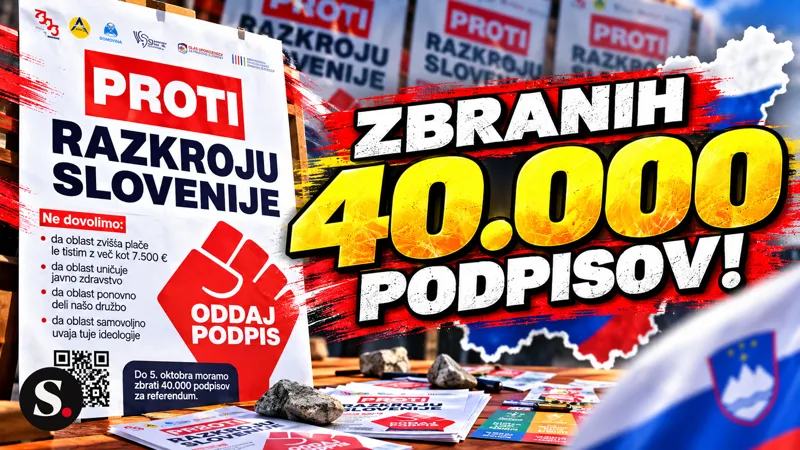 Illustration: AI
By 5 p.m. on Wednesday, the unions had collected 40,960 signatures, ten more than needed to call a post-enactment legislative referendum on the urgent law on the development of Slovenia. Signature collection continues until 5 October, after which the National Assembly (DZ), the parliament's lower house, will decide whether to call the referendum.
At a press conference in Ljubljana, Branimir Štrukelj, president of the Confederation of Public Sector Trade Unions of Slovenia (KSJS), described the achievement like this:
"In three weeks, twelve days ahead of the deadline, we have reached the point where citizens will be able to practise direct democracy. It is good for Slovenia, because it represents the pinnacle of democratic principles in any state." (translated)
The law the signatures were collected against was drafted, even before the current government took office, by MPs from NSi, SLS, Fokus, the Democrats and Resnica. The National Assembly adopted it on 11 May with votes that also came from SDS MPs. Among other things, it lowers value added tax on basic foodstuffs, allows a temporary cut in tax on some energy products, introduces a social cap, abolishes the ban on doctors from the public network working for private providers, introduces automatic retirement and the option of receiving a full salary and a pension at the same time, and lowers taxation of rents.
The proponents present the law as a step towards a better business environment and faster development of the state, a view business associations share. The unions argue the opposite: that the law benefits only the richest, takes from the majority, and also endangers public funding for education, health care, social protection, long-term care and culture.
So the name of the law and the assessment of those who collected signatures against it do not match: some see development in it, others decay. Who is right will be decided by voters, if the National Assembly actually calls the referendum.
Sources
Saj ni res. is an independent Slovenian newsroom. This is an English translation of our Slovenian story; the Slovenian original is authoritative.