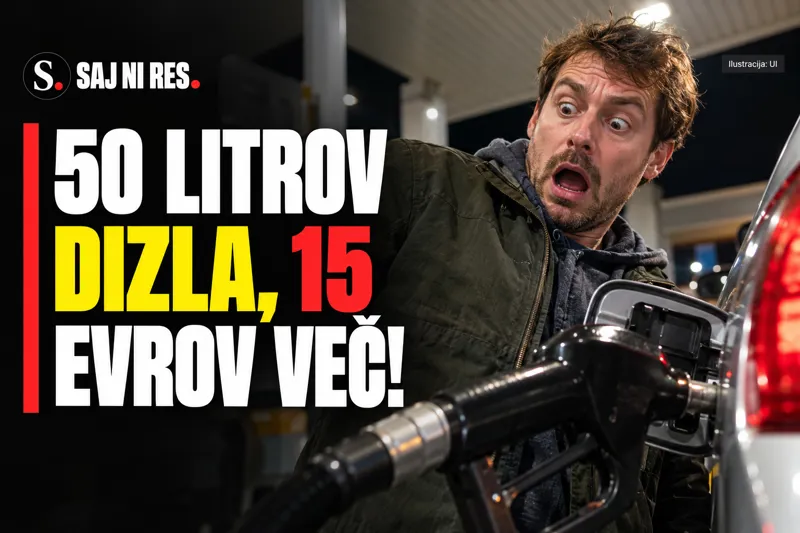
Petrol could get up to 34 cents cheaper, diesel up to 27. The government won't say if it will
EU member states have backed Slovenia's request for fuel excise duties below the European minimum. The finance ministry says it is too early to predict any cuts.
 Illustration: AI
EU member states today backed Slovenia's request for lower fuel excise duties. For drivers this is not yet a lower price at the pump: the decision is still on its way, and the government must then set the level of the duties.
The permanent representatives of the member states to the Union called on the Council of the EU to adopt an implementing decision allowing Slovenia to cut excise duties on 95-octane petrol and diesel below the minimum level set by European legislation. As reported by STA, citing the Council of the EU, the decision is expected to be formally adopted on Monday. The approval is valid for six months from the official notification to Slovenia.
The draft decision, prepared by the Council of the EU on 3 November, allows Slovenia to cut duties by up to €0.2195 per litre for petrol and up to €0.225 per litre for diesel below the minimum level in the Energy Taxation Directive.
According to STA's calculation, this means the excise duty on petrol could fall from the current €0.41759 to as low as €0.1395 per litre. Diesel is a special case: its duty, at €0.330 per litre, is already at the European minimum, so without this approval the government cannot cut the tax on it at all. With the approval, it could lower it to €0.105 per litre.
What this means for the price was calculated by the finance ministry, according to Svet24, as follows: the 22 percent value added tax is also charged on the excise duty, so every cent less in excise duty lowers the final price by 1.22 cents. At the current diesel price of €1.949 per litre, the government could in the extreme case lower it to €1.675, and a litre of petrol from €1.626 to €1.287. That is a difference of around 27 cents for diesel and around 34 cents for petrol.
This is an upper limit, not a forecast. The ministry told Svet24 that the government will decide on the level of the duties based on the movement of oil product prices, conditions on energy markets, the effects on final fuel prices and the consequences for state revenue. They added that it is too early to predict when and by how much the government will change the duties. If the Council of the EU confirms the decision, the ministry is expected to set the new level of duties in the second week of November.
Prime Minister Janez Janša said at a press conference in Metlika that the approval would give the government an additional instrument for tackling the burden of high energy prices. According to him, the six-month period makes sense above all because of winter, as global developments are expected to keep affecting gas and oil prices, and consumption is significantly higher in winter.
The government sent the request to Brussels on 31 July and supplemented it with a letter on 21 August, which the draft decision confirms. As STA reports, it justified the request with the words:
"zaradi izrednih in vztrajno visokih cen energentov, ki pomembno bremenijo slovenska gospodinjstva in gospodarstvo" (translated)
More than three months have passed from the request to today. Croatia, Spain and Sweden have already received permission to cut below the European minimum ahead of Slovenia. The request for a lower excise duty on heating oil, which the government added in September, is still waiting: the ministry explained that the European Commission is handling it separately and has not yet decided.
Brussels does not hide its reservations. The draft decision says that tax cuts that are not targeted mean considerable fiscal costs and increase demand for fossil fuels, so the permission must be strictly limited in time. The approval also does not affect EU state aid rules.
The state will therefore have to choose how much revenue it is prepared to give up so that drivers pay less for fuel. Whether that happens in mid-November, as the ministry indicates, will only be known when the government announces the new level of duties.
Sources
- Osnutek izvedbenega sklepa Sveta EU 14559/26 original source „Slovenia is authorised to apply a reduction of the rates up to EUR 0,2195 per litre for unleaded petrol used as motor fuels and up to EUR 0,225 per litre for gas oil used as motor fuels below the minimum levels of taxation“
- I/A item note 14562/26 original source „There were no objections raised against the substance of this derogation within the Working Party on Tax Questions“
- EU podprla slovensko prošnjo za znižanje trošarin na bencin in dizel media report „Države članice EU so danes podprle prošnjo Slovenije, da začasno zniža trošarine“
- EU odobrila znižanje trošarin na goriva: toliko nižje bi lahko bile cene media report „vsako znižanje trošarine za en cent v končni maloprodajni ceni odrazi v znižanju za 1,22 centa“
- Članice EU podprle slovensko prošnjo za znižanje trošarin media report „Dovoljenje za znižanje trošarin pod evropski minimum so pred Slovenijo že prejele Hrvaška, Španija in Švedska.“
Saj ni res. is an independent Slovenian newsroom. This is an English translation of our Slovenian story; the Slovenian original is authoritative.