
UN food agency cuts 500,000 people from Gaza aid because it ran out of money
The cut comes just before winter in a territory where two thirds of residents survive only on aid. Aid has to be cut because donors did not give enough, not because people need it less.
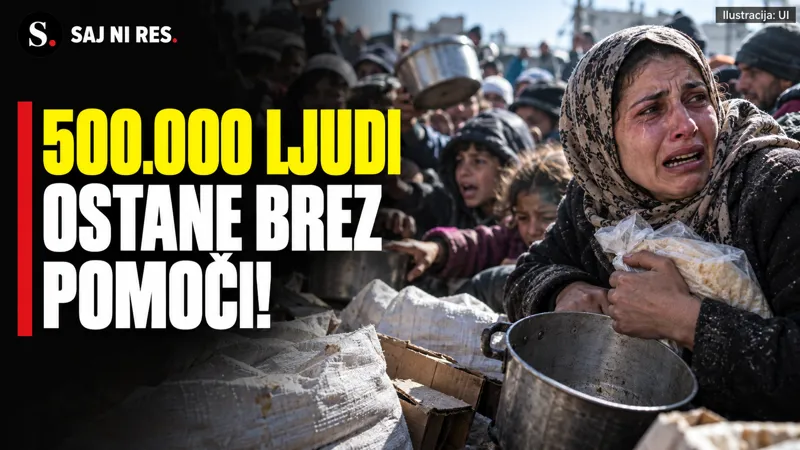 Illustration: AI
The World Food Programme (WFP), a United Nations agency, is this month reducing the number of people in Gaza it helps every month from 1.6 million to 1.1 million. Half a million Palestinians are thus losing the aid they had been receiving. The agency says it has received less than half as much money for its Palestinian operations in 2026 as in previous years. To keep key activities going over the next six months, it urgently needs another $450 million.
The cuts are concrete. The number of people to whom WFP distributes sacks of flour and food boxes every month will fall from 1.1 million to 600,000. Families will get one food parcel instead of two, and the sacks of flour will be smaller. Community kitchens will prepare 150,000 hot meals a day instead of 250,000. Families in hard-to-reach areas, for example along the so-called yellow line, which marks off the area under Israeli military control, will get a hot meal every other day, not every day.
Shaun Hughes, WFP's director for Palestine, stresses that the reason is neither needs nor access.
"It's not because needs are decreasing, or because we don't have access, because we do." (translated)
Hughes also told the news agency AFP how big the cut is.
"From this month, we are striking half a million people off the number of people we help." (translated)
Almost all of Gaza's 2.1 million residents are still displaced, and two thirds of them cannot survive without food aid. More than 80 percent of people are out of work, so they mostly cannot afford the food now available in the markets. The BBC writes that there is no cooking gas in Gaza because the Israeli government considers it a dual-use item that Hamas could use. Families therefore search the streets for plastic and cardboard so they can cook or bake bread.
Residents the BBC spoke to complained even before the cuts that the rations were not enough. Mervat al-Satari, a mother of five from a camp in Al Mawasi near Khan Younis, called the cut a catastrophe.
"It's a catastrophe! What will we do with these smaller rations? How will we feed the little ones?" (translated)
A ceasefire between Hamas and Israel was agreed a year ago, but according to the BBC attacks continue, there is no reconstruction, and Israel tightly controls the entry of goods. Experts from the IPC, which monitors food security, estimated in July that between July and December 2026, 1.4 million people would experience crisis or worse levels of acute food insecurity. That is down from 1.6 million at the end of 2025, but WFP describes the improvement as modest and fragile.
WFP will continue to support the bakeries that cover a third of Gaza's bread needs, and to provide food aid for about 300,000 women and children. In the West Bank, it already halved the number of aid recipients in September, to 200,000.
Sources
- Funding shortages force World Food Programme to cut aid to Gaza
- World Food Programme to end aid for half a million in Gaza due to funding shortfall
- Cuts force World Food Programme to end support for half a million Palestinians in Gaza
- WFP cuts aid to 500,000 Palestinians in Gaza amid funding shortages
Saj ni res. is an independent Slovenian newsroom. This is an English translation of our Slovenian story; the Slovenian original is authoritative.