
Hen cages extended six years, cat microchips scrapped: minister calls it animal welfare
The Ministry of Agriculture is extending the life of hen cages by six years, taking the chip away from cats and loosening the chain on dogs, all in the name of animal welfare.
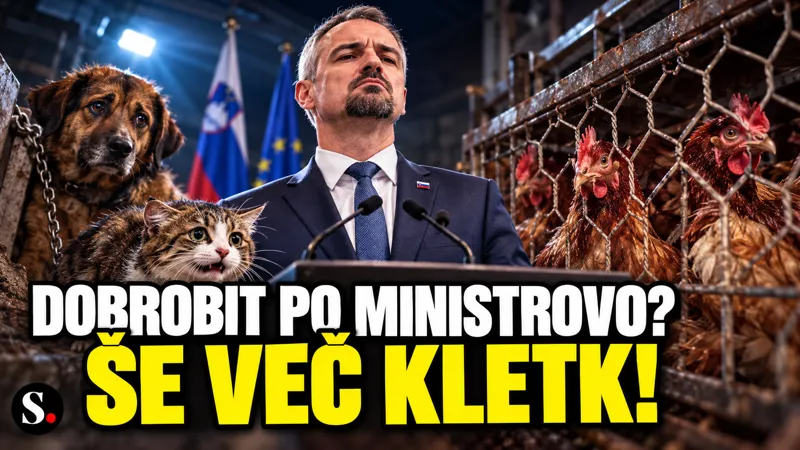 Illustration: AI
The Ministry of Agriculture has sent a draft amendment to the animal protection act out for public consultation. It repeals or postpones most of the best-known changes that the previous amendment to the same act brought in last summer under the government of Robert Golob.
Agriculture Minister Janez Cigler Kralj presented the draft at a press conference on Thursday. According to him, the working group that prepared the amendment was guided by a high level of animal welfare, and the aim is to remove what he calls activism.
"With this amendment, which is going to public consultation, we want to remove activism, meet breeders and farmers halfway, and keep a high level of animal welfare," he said. (translated)
The most tangible change concerns laying hens in enriched cages. The current law required breeders to abandon this type of farming by 1 January 2029. The amendment moves that deadline to the end of 2034, almost six years later. The minister said this allows breeders who invested in cages to write off their outlay, while the ministry will no longer put public money into renovating or building new cages during the transition period. According to the minister, the €8 million that the previous government promised breeders to adapt to the ban was never paid out. Oversight of the 35 breeders who still practise battery farming is meanwhile supposed to be strengthened.
Second, the amendment abolishes the mandatory chipping of owned cats, which was to apply from 1 January 2027. Chipping will remain mandatory only when an animal changes ownership, and there will be no more public funding for marking.
Third, the general ban on permanently tethering dogs stays, but with two exceptions: for dogs born before 1 January 2027, if the owner takes them for a walk or lets them run free at least once a day, and for dogs that guard farms at night. The minister said the two exceptions are limited in time and conditional on suitable spatial conditions.
For the castration of piglets up to seven days old, the amendment keeps the requirement for anaesthesia and analgesia, in force since the start of this year. It also allows a suitably trained breeder who has an agreement with a veterinary organisation to carry out the procedure instead of a vet. That is an important difference from the destructive version of the draft, which the ministry briefly published on the e-demokracija portal in September and then withdrew: that one allowed castration without anaesthesia.
Instead of the shelter for hoofed animals that the law envisaged, the amendment introduces additional transitional stables for all farm animals. The conditions for funding shelters are also changing: after 180 days of placement the state will no longer co-finance the care of chronically ill animals with a hopeless prognosis, and the option of seizing the vehicle of a person who illegally transports pets is also being abolished.
According to the ministry, the draft was prepared by a working group led by Andreja Bizjak, acting director-general of the Food Safety, Veterinary and Plant Protection Directorate. Besides the Chamber of Agriculture and Forestry, it included the veterinary faculty and chamber, the Ljubljana biotechnical faculty, the Maribor agricultural faculty and the association of animal protection NGOs. The public consultation will last one month, and the ministry plans to adopt the amendment by the end of the year.
Last year, 42,000 signatories demanded a referendum on the previous, stricter version of the law, to prevent it from being loosened. This time the ministry is going in the opposite direction, without asking whether anyone will sign back.
Sources
- Predlog zakona o zaščiti živali podaljšuje rejo v kletkah za šest let
- Preložitev prepovedi baterijske reje in čipiranja mačk?
- Baterijska reja, privezovanje psov in čipiranje mačk. Na ministrstvu pripravljajo spremembe
- Preobrat: Čipiranje mačk, kot kaže, ne bo več obvezno!
- Velike spremembe pri privezovanju psov, čipiranju mačk in kastraciji pujsov
- Predlagajo izjeme pri privezovanju psov in umik prepovedi reje kokoši v kletkah
Saj ni res. is an independent Slovenian newsroom. This is an English translation of our Slovenian story; the Slovenian original is authoritative.